
Deep tech has a marketing problem. Not a lack of talent — but a language barrier between those building the future and the world that needs to understand why it matters. The best marketers in this space aren't just translators, they're architects of belief.
Staying In Orbit exists to surface those voices. Each issue, we sit down with a marketing leader at a company defining what's next in space, science, and deep tech — and ask them how they think, what they've learned, and where the field is heading.
For our inaugural issue, we spoke with Katheryn Thayer at Radical AI — New York's first AI lab for autonomous materials discovery, fresh off a $55M seed round. Six weeks into her role, she has more insights to share than most do in years.
— Chandler, Founder & Chief Galactic Officer at Imagine Milk
Building Credibility in
Deep Tech

Katheryn Thayer, Head of Marketing - Radical AI
How do you explain to a general audience what Radical AI does — and what's your philosophy on communicating complex science?
When I joined the team, I assumed I'd be doing translation work. They were very excited that I'm not a scientist — that communication would require that more mass-audience editing.
What I found is that it's two fold. Deeply technical audiences will be some of your most engaged fans, all the more so if you're authentically speaking their language. So I'm really passionate about partnering with our technical staff to make sure we nail that. But you'd be missing out if you weren't also putting in a layer that's a little broader — one that gets the wider public excited about what's possible.
How do you build credibility when your audience may not fully understand what you're doing yet?
Starting with a scientific audience — making sure you have them on board and getting them to engage with the more technical aspects — is a powerful way to bridge into larger audiences. I wouldn't recommend starting with a general audience.
A lot of technical teams try to say too much. Finding the discipline to atomize your message — to say one thing here and another thing here — and letting the right audiences find it. The algorithms will do that work for you.
What kinds of moments or milestones can deep tech companies use to build broader brand recognition?
One of the most powerful brand assets we have is the governor's press release about our new office space, which highlights Radical AI as the first-of-its-kind AI lab in New York. People can feel hometown pride over that, even if they don't fully understand what we do. There are a lot of opportunities across deep tech to create something like that — moments that resonate without requiring you to explain everything.
In The Imagine Milk Orbit 🚀
🚀 Mantis Space stepped out of stealth on March 12, 2026 with $10M in seed funding and a bold mission: beam solar power to spacecraft in orbit. We built their launch website, debut animation, and social graphics package — everything they needed to make the moment count. Check out their launch video below!
🚀 We are launching a science creator program! Are you an engineer, science communicator, or space enthusiast ready to build an audience around your work? Our creator program gives science and space creators the community, tools, and partnerships to grow. Apply for early access and opportunities.
🚀 Find us at the Space Symposium. If you’ll be in Colorado Springs April 13–16, come find us and chat space marketing 🙂
🚀 NY Space Week is on the horizon. We are teaming up with Empire Space for New York Space Week 2026! Follow our channels for updates on panels & rooftop happy hours.
Science Communicator
of the Month:
👩🚀 Laysa Lage
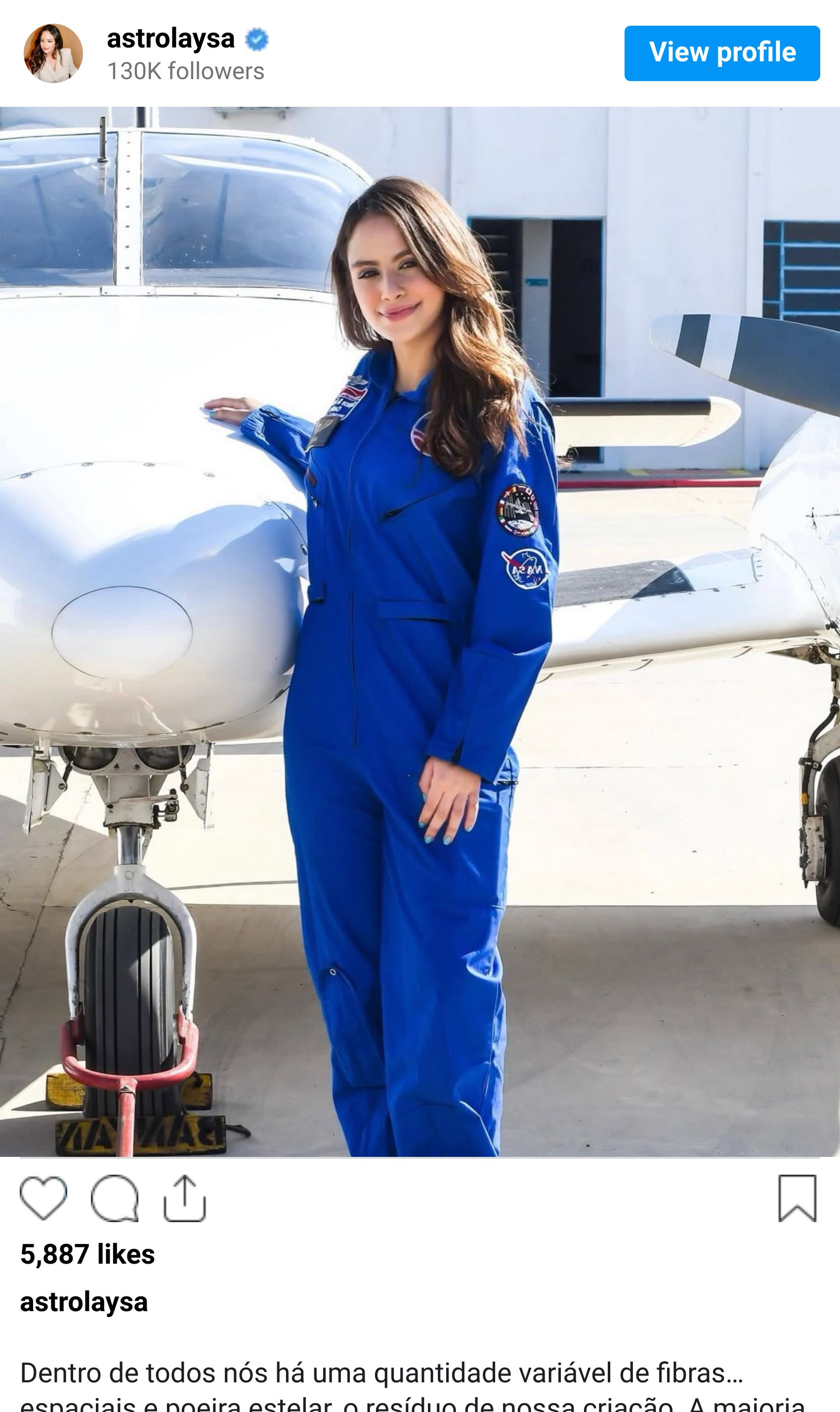
Before turning 18, Laysa discovered a previously unobserved asteroid, 2021 PS59, officially designated by NASA, and earned a National Science Medal from Brazil’s Ministry of Science, Technology and Innovations.
She is a Creative Technologist and Science Content Creator who translates ambitious ideas in aerospace and tech. She has spoken alongside astronauts for crowds of over 10,000, developed proposals addressing NASA’s needs, and is a violinist with plans to perform in orbit.
